How to Build a Prayer Habit That Lasts
Practical steps to make daily prayer a consistent part of your life
 Pray FocusJune 20, 202610 min
Most people who stop praying do not stop because they lost their faith. They stop because they lost their rhythm. They miss a day, then two, then a week, and before long prayer feels like something they used to do. The problem is rarely confusion about how to pray. The problem is consistency.
Prayer is both a relationship skill and a habit skill, and both matter. You can know exactly what to say to God and still struggle to show up regularly. That is not a spiritual failure. It is a human one. Every lasting relationship requires not just love but also rhythm: regular contact, predictable presence, showing up even when you do not feel like it.
This guide applies proven habit-building principles to prayer. You will learn how to start small, anchor prayer to your daily routine, handle missed days without guilt, and build a streak that sustains itself. These are the same principles that help people exercise daily, write consistently, or learn a new language. They work for prayer too, because God meets us in the ordinary, repeated act of showing up.
Step-by-Step Instructions
Start with 2 minutes, not 20
The biggest mistake people make when starting a prayer habit is setting the bar too high. They commit to 30 minutes of morning prayer, do it for three days, and then quit when life gets busy. A 2-minute prayer you actually do every day is infinitely more valuable than a 30-minute prayer you skip. Your goal right now is not depth. It is consistency. You are training your brain to associate a specific time and place with talking to God. Once the habit is locked in (usually after 3 to 6 weeks of daily practice), you can gradually extend the time. Many people naturally find themselves praying longer once the habit is established, because they start to enjoy it. For your first two minutes, keep it simple: thank God for one thing, ask Him for one thing, and sit quietly for 30 seconds. That is enough. Do not let perfection be the enemy of showing up.
Anchor prayer to an existing habit
Habit researchers call this "habit stacking." You attach a new behavior to something you already do every day, so the existing habit becomes your trigger. You do not have to remember to pray. Your routine reminds you. Examples: pray right after you pour your morning coffee (while it cools). Pray right after you brush your teeth at night. Pray during your commute (eyes open, obviously). Pray right after you sit down at your desk before opening your laptop. The key is to pick something you do every single day without thinking, and attach prayer directly after it. The formula is: "After I [existing habit], I will pray for 2 minutes." Write this sentence down and put it somewhere you will see it. The more specific your trigger, the more likely you are to follow through.
Choose a fixed time
Morning, lunch, or evening. Pick one and stick with it. Your brain needs a consistent trigger, and time of day is one of the strongest cues for habit formation. Morning prayer has a long tradition. Jesus Himself, "rising up a great while before day, went out, and departed into a solitary place, and there prayed" (Mark 1:35). Starting the day with God sets the tone for everything that follows. But if you are not a morning person, do not force it. An evening prayer you actually do beats a morning prayer you sleep through. The best time to pray is whenever you can be consistent. Some people pray at lunch, using a few quiet minutes before eating. Others pray right before bed. Daniel prayed three times a day (Daniel 6:10). There is no single right answer. There is only the answer that works for you, repeated daily.
Related Guides
How to Pray the Rosary
A complete step-by-step guide to praying the Rosary with all four sets of mysteries
How to Pray the Angelus
Learn the ancient prayer traditionally prayed three times daily at 6 AM, noon, and 6 PM
How to Pray the Divine Mercy Chaplet
Pray the chaplet given to St. Faustina Kowalska using ordinary rosary beads
Learn to pray.Make it a daily habit.
One email at a time, at your pace
Join our free email course and learn simple, time-tested ways to pray, with one small thing to try each time, so prayer slowly becomes part of your day.
- 8 short lessons: the Daily Examen, Lectio Divina, ACTS and more
- One tiny exercise each time, so praying becomes a habit
- Gentle and practical, never preachy. Free, forever.
APP BLOCKING
Pray before you scroll.
DAILY SCRIPTURE
From 3 Christian traditions.
AI BIBLE CHAT
Talk to the Bible.
Turn mindless scrolling into a prayer habit

Point your phone camera at the QR code.
Download today for free
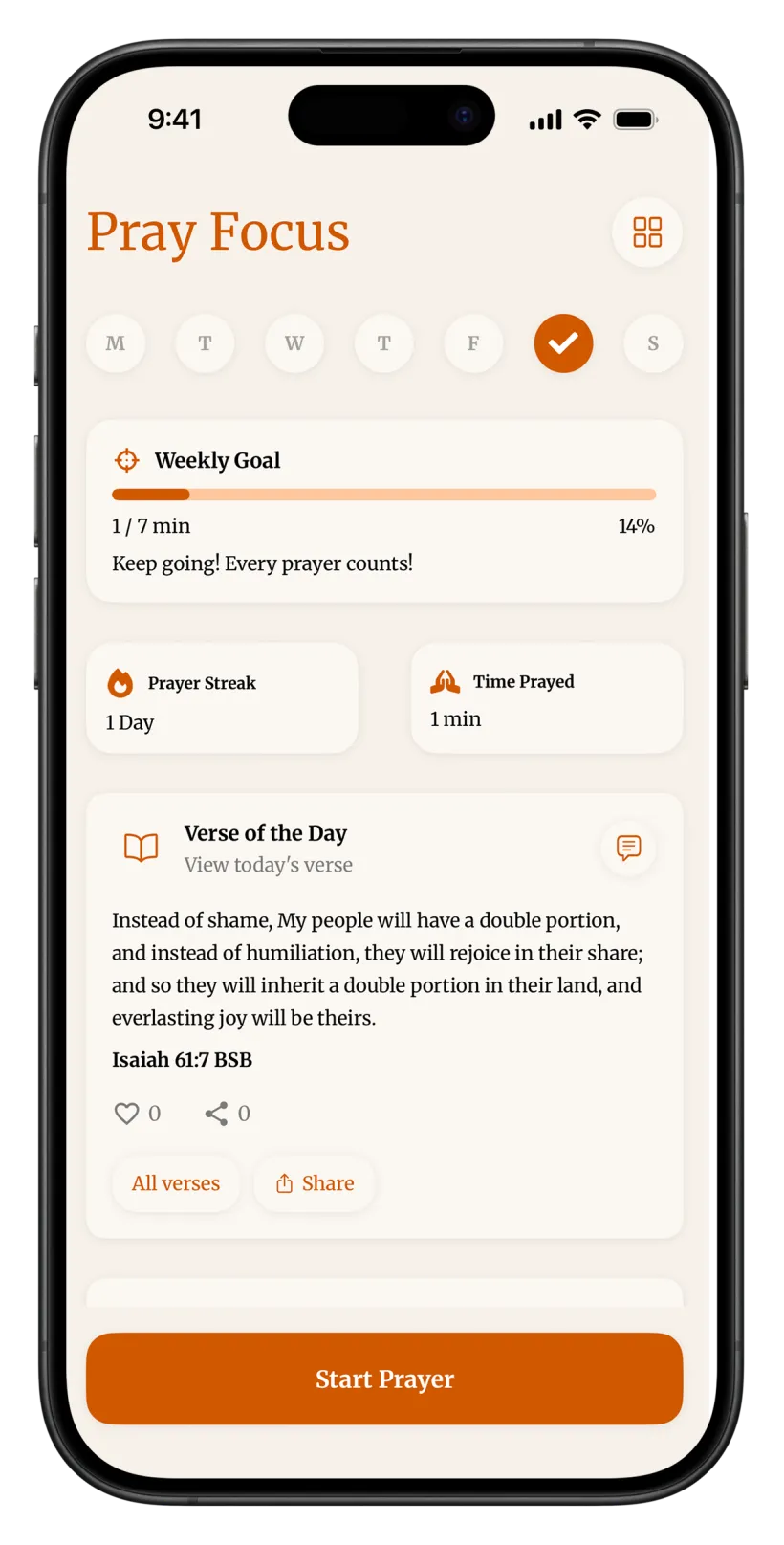
It takes 2 minutes to get started. Download this Christian prayer app, set up the app blocker, and begin building a praying habit.
